
 A child’s transition from preschool or home to kindergarten is a big event for both the child and her parent. For many children, kindergarten represents the first experience with formal education outside of the home; for others, it means getting to know new teachers, new friends, a new building, and a new set of rules. Ready Freddy’s Kindergarten Club Curriculum is designed to help both children and parents get excited and prepared for the transition to kindergarten.
What It Is
The club curriculum is divided into six sessions, each focused on a different topic important to helping families transition to kindergarten and to promoting academic success:
- Get Ready, Freddy — Each child is unique; Parents know best!
- Setting & Achieving Goals — Working together to accomplish goals
- Sharing & Friendship — The importance of social-emotional development
- Reading & Writing — Much more than ABCs
- Numbers — More than counting
- Freddy’s Ready — You’re off!
For example, the focus of Session 1, “Get Ready, Freddy,” is about the importance of recognizing that every child has unique strengths and needs and that parents have a role in advocating for their children. Click here for sample content from Session 1.
Each session has the following components:
- An Introduction — for explaining the focus of the session to parents and children
- A Parent-Child Activity for encouraging quality parent-child interactions and modeling activities that promote school readiness and academic success
- A Parent Activity for providing parents with the information they need to support their children’s transition to kindergarten and lay the foundation for long-term parent involvement
- A Child Activity for exposing children to the kinds of experiences and expectations they’ll encounter in kindergarten
- A Read Aloud for demonstrating how to promote children’s love for books, content knowledge, and vocabulary by reading stories
- A Take-Home Activity for encouraging parents to continue and practice at home what was discussed during the session
Why It Works
Parents often serve as their child’s first educators before school. When parents are active partners with their child in preparing for kindergarten, they continue to play the teacher role as they help their child to develop a love of learning and deal with anxiety surrounding the transition to school. Kindergarten Clubs encourage parents to continue providing educational support for their children throughout kindergarten. This encouragement reinforces the parents’ educational role and gives parents some skills and confidence to be able to repeat early learning activities at home. For example, during the parent-child sessions, instead of directly teaching an activity to the child, facilitators coach parents to teach the activity. Facilitators also demonstrate ways for parents to be involved but hands-off (i.e., not doing the project for their child) during their child’s learning. They encourage praise for effort rather than praise for the final product.
EXAMPLE: Parent-Child-Facilitator Activity
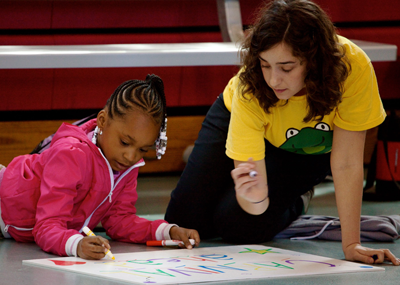
The following instructions from a parent-child art activity prompt parents to model language that promotes sharing between children.
Tell parents and children that the goal for the activity is for the children to work together to make pieces of art. To accomplish the goal, they will need to talk to each other and cooperate. Let parents know that their job is to prompt the children to communicate with each other—they can supply words for their child, BUT they should not do the talking for him/her!
As the children roll the can back and forth, encourage parents to model kind things to say. For example, a parent might say, “That was a good roll. [Child‘s name,] say, “Good roll!” or, “She rolled that really fast! She must be strong, don‘t you think, [child‘s name]?”
Encourage parents to help their children negotiate when to take the painting out and to whom the painting belongs. For example, if one child is getting bored, his/her parent might have their child ask the other child if he wants to take the painting out yet. If the other child says no, the parent could say, “Hmm. She‘s not finished yet. We could compromise. Why don‘t you ask if she could stop after 10 more rolls?”
By promoting teacher-parent, parent-parent, teacher-child, and child-child interactions within one curriculum, Kindergarten Clubs follow quality transition principles.